


What the Pool Boom Taught Us About Construction, Systems, and Long-Term Thinking
COVID changed a lot of things. One of them was the backyard.
Demand for swimming pools exploded almost overnight. With travel shut down and families investing in their homes, pools went from “nice-to-have” to “must-have.” To meet that demand, many excellent landscapers, excavators, and general trades pivoted into pool construction.
To be clear: these are skilled professionals. They understand grading, drainage, concrete, timelines, and project management. None of that is trivial. But pool construction isn’t just construction — it’s systems engineering, chemistry, hydraulics, energy management, and long-term serviceability all rolled into one.
And that’s where the steep learning curve showed itself.
We aren’t builders. We live entirely in the aftermarket: service, maintenance, repair, and upgrades. That gave us a unique vantage point. We saw what worked beautifully — and what quietly failed months or years later.
We encountered:
• Modern equipment installed without system-level understanding
Variable-speed pumps, salt systems, heaters, automation — powerful tools when designed correctly, problematic when they’re not integrated properly.
• Salt chlorine generators paired with automatic covers, with no interlocks or fail-safes
Covered pools staying closed for days or weeks while salt systems continued producing chlorine, leading to over-chlorination, damaged surfaces, and premature equipment wear — all preventable with proper design.
• Design choices that ignored future maintenance
Returns that couldn’t be reached for winterization without a ladder or boat. Pools where installing a winter cover required gymnastics. Beautiful on day one, frustrating forever after.
• Material selections that made sense for landscaping, not pools
Stone and metals that shed calcium, leach iron, or rust when constantly exposed to pool water — staining surfaces and creating ongoing chemistry battles.
• A near-total absence of pool chemistry knowledge
Chemistry isn’t optional. It’s foundational. Without it, even the best equipment and finishes degrade faster than they should.
But the single biggest issue we saw wasn’t equipment or design.
It was education.
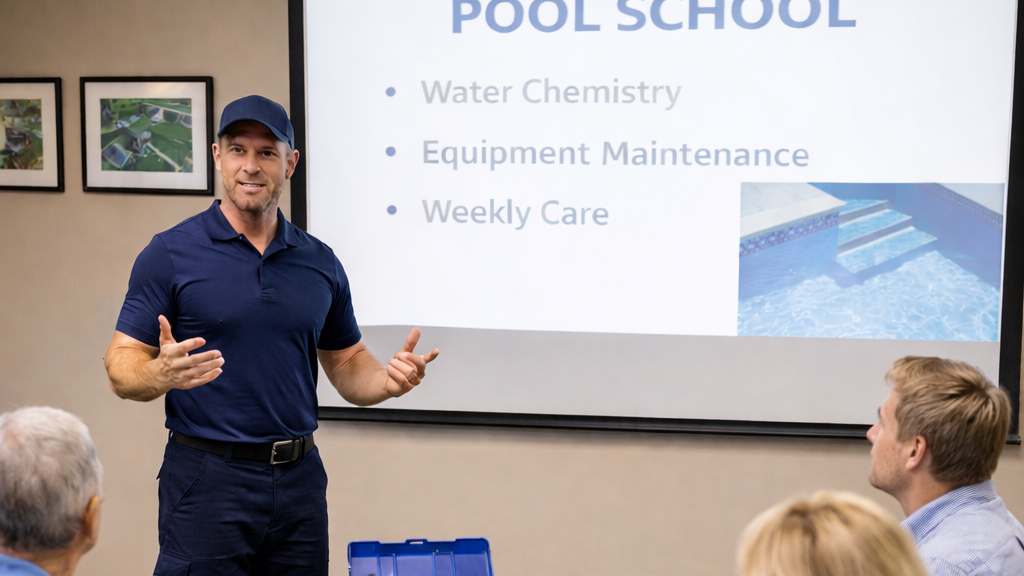
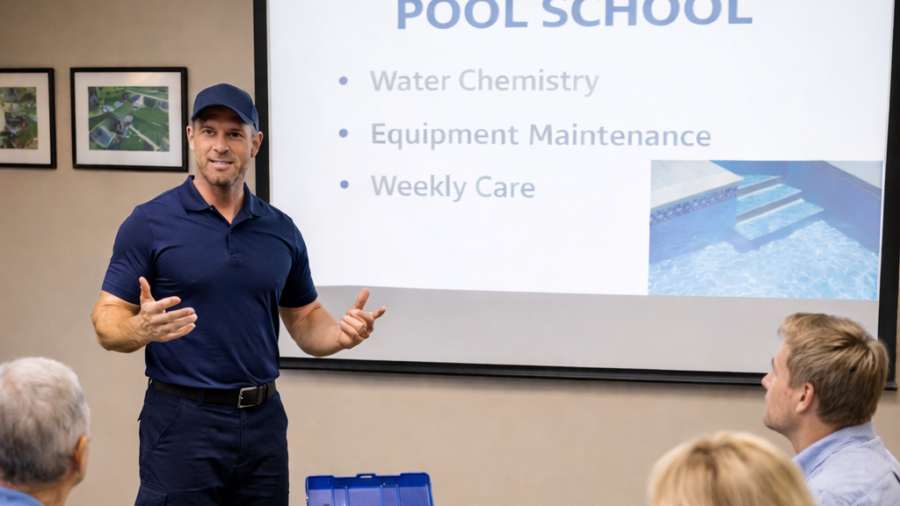
Many builders simply didn’t have the knowledge — or the time — to properly transfer operational understanding to the homeowner once the build was complete. “Pool school” wasn’t a luxury; it was skipped or treated as an afterthought.
At the same time, COVID-era pool pricing was astronomical. Homeowners were effectively buying a Ferrari-level asset — and being handed the keys without being taught how to drive it, maintain it, or avoid expensive mistakes.
The result?
Confusion, misuse, accelerated wear, water chemistry issues, and frustration — none of which were inevitable.
That experience shaped our philosophy.
We place enormous emphasis on teaching. Not just fixing. Not just servicing. Teaching homeowners how their pool actually works, how systems interact, what matters daily versus seasonally, and how small decisions compound over time.
Because a pool isn’t just a structure.
It’s a living system that needs to function efficiently, safely, and predictably for decades — not just look good on turnover day.
The COVID pool boom is behind us now. What remains are the lessons. And for those of us in service and maintenance, the privilege — and responsibility — is helping homeowners truly understand what they own.
By Mark P. Leaman – President, Vaughan Pool Supplies